
Thursday, 11 Jun 2026
The Employer Nomination Scheme (Subclass 186 visa) is one of the most popular visa subclasses for skilled workers wishing to gain Australian Permanent residency as an employer-sponsored skilled visa. There is often confusion among applicants when choosing between the Direct Entry (DE) and Temporary Residence Transition (TRT) streams.
Both result in PR, but requirements, eligibility and routes are different. We will collectively define 186 DE and 186 TRT, and outline who is eligible to apply, as well as understand which one might be more appropriate for you based on your employment status in various Australian states, such as NSW, VIC, QLD, and WA.
The Employer Nomination Scheme (ENS) Subclass 186 visa is a permanent skilled visa for an employer-sponsored skilled visa subclass 189 visa applicant. It enables workers to reside and work in Australia permanently. Working on the job pathway and Skilled Independent visa pathway are the two main pathways to apply for the 186 visa, before you can understand the difference between the streams.
Based on their experience and visa history in Australia, these streams are for a variety of workers. The visa operates under the same visa regulations across all Australian States but viable job offers and sponsorship opportunities may differ.
One of the more popular visas for skilled people to come to Australia on permanent residency is the 186 Direct Entry visa. The DE pathway is different to other visa streams in that you do not need to obtain a temporary work visa before applying for this visa, and your visa application can be nominated directly by your employer, provided that you meet the key criteria below.
To be eligible, you need to:
In states such as Victoria and New South Wales, this is a common avenue for employers to recruit suitably qualified staff when they are unable to find someone locally able to perform the required duties.
The TRT permanent visa stream is for those already in Australia on a temporary skilled visa, typically the subclass 482 visa. This is one of the most common progression paths for 482 to 186 TRT transition, and is considered to be a less bumpy long-term pathway. Let's look at the major conditions that you should know about when determining eligibility for 186 TRT.
TRT is very common in states such as Queensland and Western Australia in sectors that have long skill shortages, such as mining, hospitality and construction as well as healthcare.
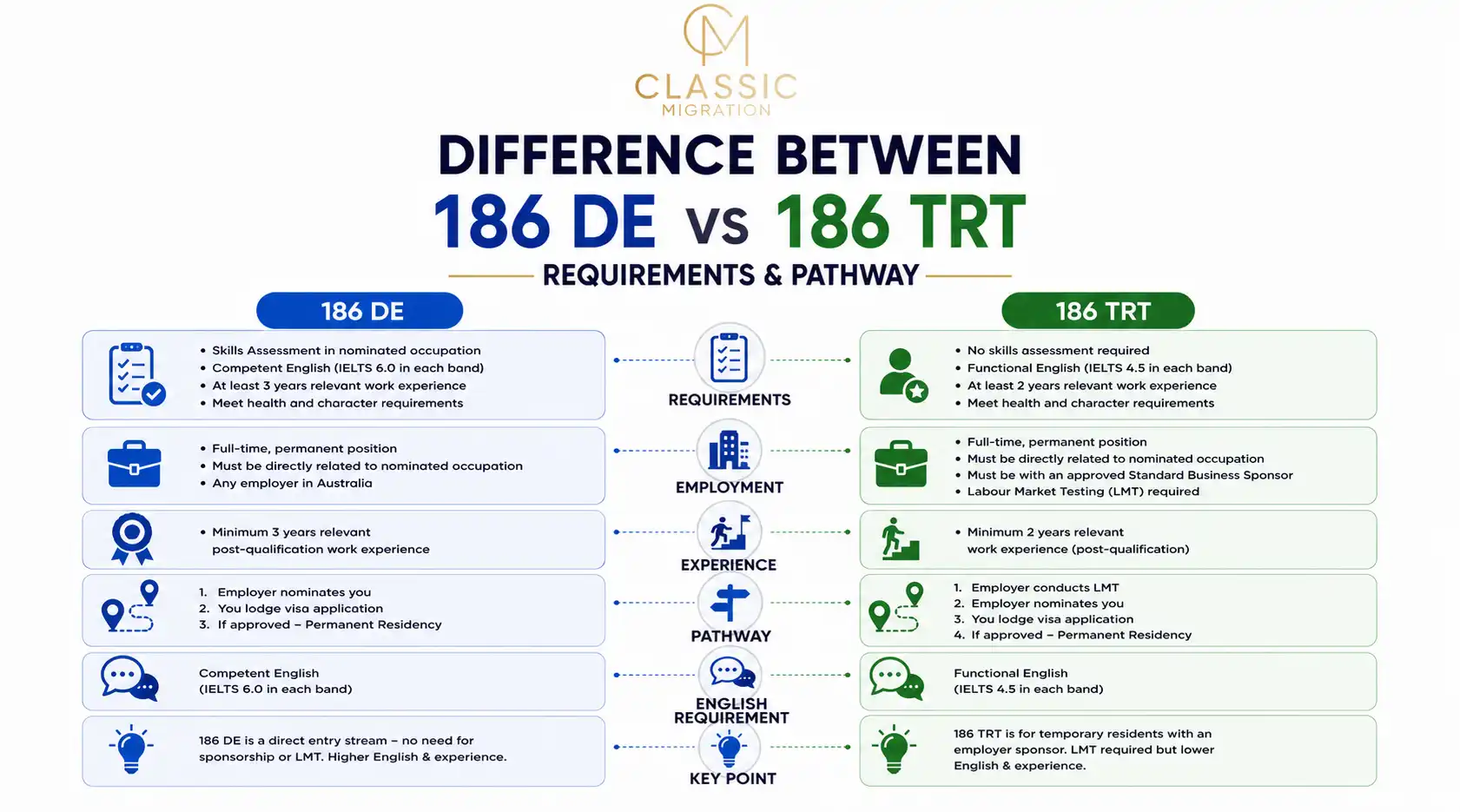
This decision is based on your current visa status, work experience and country of application for visa. Both routes result in an Australian permanent visa on the basis of employer sponsorship; however, there are differences in eligibility criteria. The following table will help you to understand which one might be suitable for you.
| Feature | 186 Direct Entry (DE) | 186 Temporary Residence Transition (TRT) |
| Location | Can apply from inside or outside Australia | Must be working in Australia |
| Work Experience | 3+ years skilled experience | 2 to 3 years with sponsoring employer |
| Visa Type Before Apply | Not required | Must hold 482 or eligible visa |
| Skills Assessment | Required | Usually not required |
| Employer Requirement | Nomination required | Same employer sponsorship required |
| Pathway Type | Direct PR application | Transition from temporary visa |
In Simple Terms
When evaluating the two streams, the 186 Direct Entry (DE) and 186 Temporary Residence Transition (TRT), there is no one "better”. There are various route options depending on individual circumstances, employment experience and visa status. Applicants from outside Australia and those who gained sufficient skilled work experience but have not worked with an Australian employer on a temporary visa are usually better suited to apply through the Direct Entry (DE) stream 186 visa category.
Conversely, with a 482 Skills in Demand/TSS visa (or other appropriate visa) classification, and an employer who has sponsored you, the 186 Temporary Residence Transition (TRT) stream can be a more straightforward and easier route to permanent residency if you have worked for the sponsoring employer for the necessary length of time.
If you choose the Direct Entry (DE) stream, you need to go with it, as most applicants end up in this pathway.
If you qualify to apply to the 186 Temporary Residence Transition (TRT) Stream, you should do so when:
To put it simply, DE is more suited to applicants who apply directly to the visa classification, based on their skills & experience, while TRT is for those who are already working in Australia on a temporary visa and apply for a permanent visa based on their skills & experience.
There have to be some requirements to be fulfilled if you apply through the 186 Direct Entry (DE) stream or the 186 Temporary Residence Transition (TRT) stream. There are a number of fundamental criteria that are relevant to most applicants; however, some of these will vary between the two pathways.
Also, your jobs may prioritize processing under the Employment Nomination Scheme (ENS) so that these occupations are specifically located in relevant regional areas. This is irrespective of the fact that nothing will be altered regarding the visa requirements.
Some changes have been implemented concerning Australia's Subclass 186 Employer Nomination Scheme, commencing from 1 July 2026. The updates include issues relating to salaries and other important matters concerning the DE and TRT visa programs.
Changes Noted: The thresholds related to the salaries of nominated skilled visas have been enhanced by the Australian Government, considering the current state of the labour market.
An increase in the Core Skills Income Threshold (CSIT) to $79,499 AUD (from $76,515 AUD)
The above-mentioned salary thresholds represent changes in the current labour market and wage rate of Australia.
The Direct Entry stream now strictly follows the updated Core Skills Occupation List (CSOL), which includes 456 eligible occupations. These occupation-specific requirements are assessed carefully during both nomination and visa processing. The description of the job should correspond with the occupational class and its skilled work.
DE stream utilizes the CSOL structure exclusively
A new visa processing priority system has been implemented under the Ministerial Direction No. 105. It allows applicants nominated by accredited sponsors to receive priority treatment due to their employer's good history of compliance with the Department of Home Affairs' regulations.
Processing times vary depending on stream type, employer, and occupation demand.
Note: Actual processing time will depend upon various factors, including application complexity, occupation shortage level, quality of documentation provided and nomination criteria, among others.
More stringent post-grant requirements for compliance by both employers and visa applicants have been made to ensure adherence to visa conditions.
Must work for the sponsoring company for at least 2 years
These duties are enforced by the Department of Home Affairs. Non-compliance with these requirements without any justified reasons could result in immigration repercussions.
Although the 186 visa program is a federal visa program, the demand in each state is different in accordance with their industrial needs. Despite there being no state-specific nomination conditions required for the Subclass 186 Visa, the labour market requirement remains vastly different from one state to another.
Queensland and Western Australia:
Victoria and New South Wales:
Regional areas in Australia:
It is crucial to be aware of the difference between 186 DE and 186 TRT when selecting the pathway for permanent residency in Australia. Direct Entry (DE) stream is typically for skilled workers to apply for a visa on merit as a direct applicant and Temporary Residence Transition (TRT) is for skilled migrants who are already in Australia and wish to apply for permanent status. The most suitable choice is dependent on individual factors, employment background and visa status.
There are times when you may feel overwhelmed by which path is best for you and Classic Migration can help you with professional advice every step of the way! We are a reliable migration agent in Canberra that advises applicants on their eligibility, assists them in the preparation process and provides them with guidance and information on how to proceed with their 186 visa application with confidence. From the DE stream or the TRT stream, we are here to help you with every step.
The only significant difference is the process of obtaining permanent residence. The 186 Direct Entry (DE) stream is for skilled workers who apply for PR directly, whereas the 186 Temporary Residence Transition (TRT) stream is for eligible skilled workers who are currently in Australia and are applying to become permanent on an eligible temporary work visa (e.g. 482 visa).
Eligibility for the DE and TRT streams is different; this cannot be done as a simple switch. If your situation alters, e.g. if you gain the necessary work experience with your sponsoring employer, you might be able to apply under the TRT stream instead.
The Direct Entry (DE) stream will require applicants to obtain a positive skills assessment result in many cases, where it is required for the occupation. A skills assessment is usually not required for the 186 Temporary Residence Transition (TRT) stream, but applicants must still satisfy all other requirements.