Thursday, 20 Aug 2026
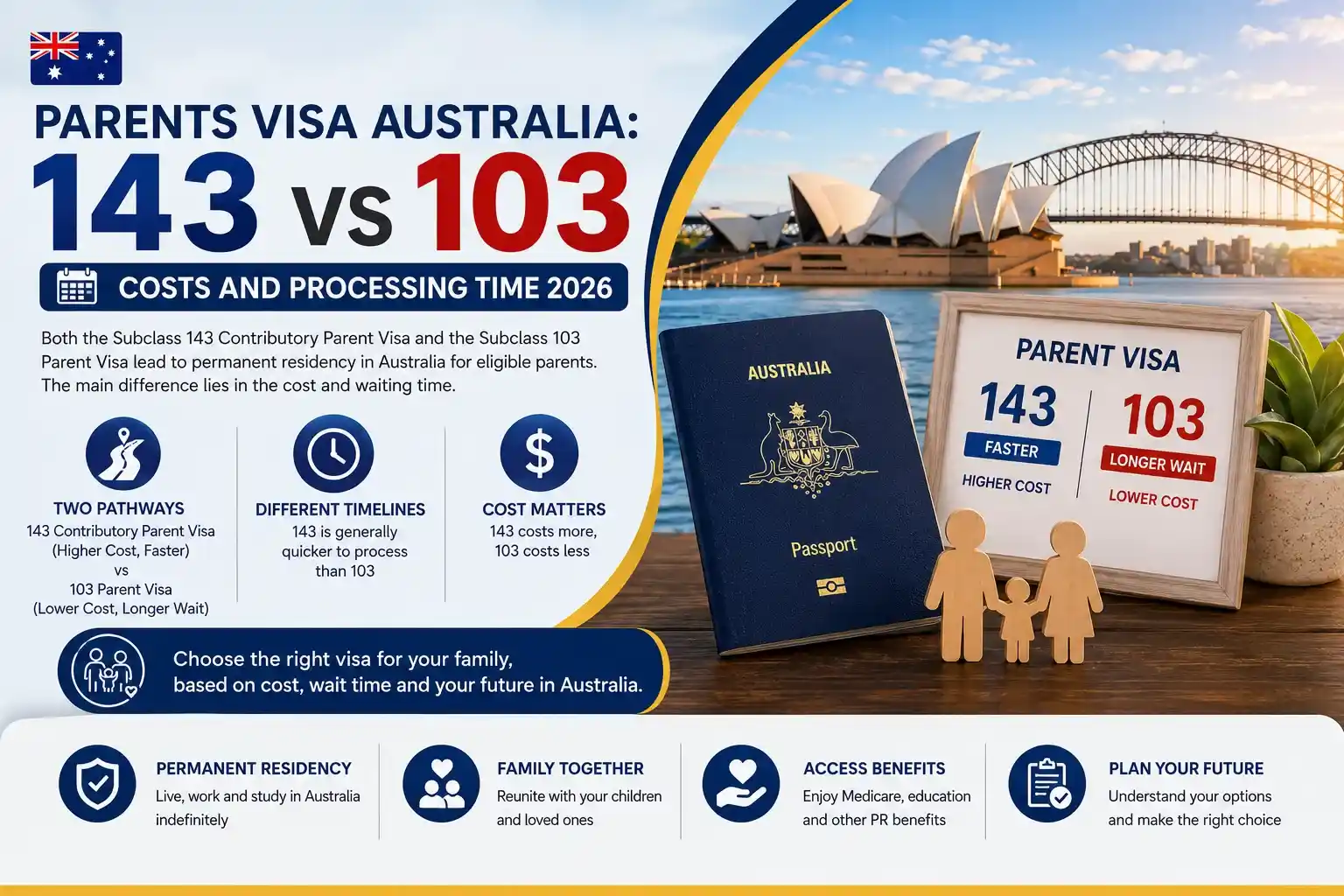
Moving to Australia to improve proximity to your children is a key long-term stressor for many parents. It can be confusing though, when trying to determine which visa is a better option, especially with regards to the difference between the Subclass 143 Contributory Parent Visa and the Subclass 103 Parent Visa. While both visas can provide eligible parents with a pathway to permanent residency in Australia, there is a significant difference in their costs and processing times.
The Subclass 143 visa pathway is more expensive, but is generally quicker to process than the Subclass 103 pathway, which is less expensive but much longer wait time. Understanding these differences can help you make a selection as to which may be right for you. We will explore both the 143 visa and the 103 Parent visa, their conditions, and costs, perhaps even their processing times, and discuss what you would must realize when applying for these visas in 2026.
The Subclass 143 and Subclass 103 are both permanent Parent visas for eligible parents of Australian citizens, Australian permanent residents or eligible New Zealand citizens. Parents can permanently live in Australia by both visas.
The only key distinction is the cost and wait time. The Subclass 143 is a subclass 103 Contributory Parent Visa, and has a much higher visa cost and a shorter processing (waiting) period. Due to the Parent visa capping system and queue in Australia, the wait time for the Subclass 103 can be much longer than the Subclass 143, and its cost is also low. The 143 visa will cost more, but may be faster, whilst the 103 visa will cost less, but the waiting period is normally far longer.

The Subclass 143 Contributory Parent Visa is an Australian Permanent (143) visa granted to eligible parents who wish to come to Australia with their children. It is a permanent visa, which means that if a visa application is successful, the visa holder will be able to stay in Australia indefinitely and provides the visa holder access to the benefits available to Australian permanent residents, subject to the eligibility and requirements. The 143 visa, as opposed to other Parent visas, is much more expensive.
Application for the Subclass 143 Contributory Parent Visa requires a number of Australian Government requirements to be met. These requirements aim to verify your association with your child in Australia, your family situation and if you are compatible with each of the relevant health, character and sponsorship requirements. Various factors determine admission eligibility, but here are some of the most important factors involved in admission decisions.
Be sure to review criteria for eligibility before applying. Just checking the minimal minimums is not a poised and sure chance to receive visa approval.
Subclass 143 visa is a Contributory Parent Visa, this costs more than the Subclass 103 visa. The government visa application charge is paid in installments, and there may be other expenses, such as for health exams, police certificates and biometrics.
Processing times also vary and it is not advised to count on times of 25 years or more. Applications for the subclass 143 visa are subject to Australia's capping and queueing system and typically considered to be a higher priority for processing than the non-contributory Parent visa. Applicants should refer to the latest information on Parent visa queues released by the Department of Home Affairs for the most current information.
The Subclass 103 Parent Visa is a permanent visa for those children with eligible parents who wish to live in Australia with their parents. Greatest benefit it has is that it is considerably cheaper to apply for a visa when this subclass compared to AUS 143 Contributory Parent Visa.
There's just one thing on the whole though, which can't be overlooked—the reason for the lower cost is precisely the length of time involved. The 103 visa falls under the non-contributory Parent visa subclass 103 visa category and is affected by the Australian Parent visa capping and the queueing system. This can mean that a lot of time may be waiting in queue while the applicant waits for his application's progress.
The main conditions for the visa (Subclass 103) are much the same as for other Parent visas. General conditions for applicants to apply and have the offer for a placement in Australia accepted are an eligible child placed/resided in Australia and the required family, sponsorship, health and character condition(s).
Key requirements are:
Many of the criteria are the same for the subclass 143 visa, but the most significant distinction between the two visas is the Parent visa's cost along with its position in the processing and visa queue system.
The government visa application charge for the Subclass 103 visa is also considerably lower than the Subclass 143 visa, which can make it a more viable opportunity to apply for the visa at this stage. It is important to note by applicants that they should take particular consideration with regard to the extended waiting period before taking a decision about which visa they can apply for.
103 visa will include the Parent visa capping and queueing system and the processing priority of the non-contributory Parent visa is likely to be less than the Contributory Parent visa. The wait times for processing a Parent visa are not readily available and the Department of Home Affairs provides the most up to date information on its queue processing dates in an official release.

Both the Subclass 143 visa and the Subclass 103 visa allow the sponsor eligible to live permanently in Australia with their children. But when deciding between the two it can be tricky as they often vary so much in terms of cost and waiting times/processing order. Although the Subclass 103 will cost less than the Subclass 143, the wait times may be quite long, depending on the demand. The Subclass 143 tends to have a significantly shorter waiting time for the majority of cases, however, it is more expensive in general.
There are some important differences between these that should be taken into consideration when considering which visa might be better suited. In the table below, a comparative analysis of the Subclass 143 visa and the subclass 103 visa (Parent visa) will be given to help understand the differences between both visas.
|
Feature |
Subclass 103 |
|
|
Visa type |
Contributory Parent Visa |
Parent Visa |
|
Permanent visa |
Yes |
Yes |
|
Visa cost |
Higher |
Lower |
|
Queue |
Generally shorter |
Significantly longer |
|
Processing priority |
Higher priority |
Lower priority |
|
Best for |
Parents who can afford a higher cost and want a shorter wait |
Parents looking for a lower-cost option and willing to wait longer |
Subclass 143 visa is not necessarily the best visa to apply for, for every applicant. The right visa is mainly based on your finances and willingness to wait. 143 visa is if you're looking for a quicker route and can afford the higher cost. The 103 visa might be a consideration if cost is key and you're okay with a significantly long wait.
Australia has a capping and queuing system for parent visas. This simply implies restriction of the Australian Government for the number of Parent visas issued annually. After the allocation of visas in a visa category is complete, eligible applications can be added to a waiting list until it becomes available again to fill.
Contributory Parent visas (including the Subclass 143 visa) are likely to be processed before non-contributory Parent visas (including Subclass 103 visas). This is why the 143 visa queue (visa subclass 143) is both quicker to clear and more popular than 103 visa queue. But the higher the priority at which the visa is processed, the faster it may be granted or the quicker its decision may be made, but not necessarily. Each applicant will need to still satisfy all requirements for a visa and processing times may differ between applicants, based on the criteria and workload.
There is no single Parent visa that is right for every family. The most suitable option will depend on your budget, family circumstances, and how long you are willing to wait. For many parents, the Subclass 143 visa may be a more suitable option despite its higher visa fee, as it generally offers a much shorter processing pathway than the Subclass 103 visa. Although the Subclass 143 visa is more expensive, it can provide a quicker route to obtaining a Parent visa.
For families looking to maintain a low visa price may be a better choice, as they can opt for the Subclass 103 visa. But, the candidates must be ready for a much longer waiting period. It is important to compare both cost and the time you may have to wait before you make a decision. When selecting the appropriate visa, you have to take into account what is important to you and your household.
The main difference between the Subclass 143 Visa and Subclass 103 Parent Visa is the time it takes to get an invitation and the likely cost. While the visa cost is slightly higher for the subclass 143, the visa is usually given processing priority, the subclass visa 103 visa cost is lower but the wait time is much longer. It is important to take into account your budget, family situation, and willingness to wait before deciding whether or not to qualify for a mortgage with that lower payment. Estimation of whether or not Parent visa processing is affected by capping, queueing and processing priorities is also important because it is best to check the latest information before applying.
If you are not sure if you would qualify for one of the Parent visas, Classic Migration can advise you based on your circumstances. As a registered migration service in Canberra we are able to guide you about your visa options, eligibility and application. We are associated with the Migration Agents Registration Authority (MARA), ensuring you receive professional migration guidance. As one of the best migration agents in Canberra, we are here to be your help when it comes to your migration journey, and we will give you all the clear and personalized help you need to make it smooth.
1. Partner Visa Processing Time 2026: Latest Updates
2. Australia Visa Fees Rising July 1, 2026: Lodge Now or Pay More
Generally, yes. The subclasses 143 (Contributory Parent Visas) have a higher processing priority than Subclass 103 visa, and for this reason, the subclass 143 visa typically gets processed in a shorter time. However, capping, queuing and applications being processed can still conceivably result in varying waiting times.
The Subclass 143 visa is much more expensive as compared with the subclass 103 visa because it is a Contributory Parent Visa. The price of government visa application charge is paid in installments, and other costs may be imposed for such items as health checks, police certificates etc. Always check government visa charges before submission of applications.
There are two basic differences between these two visas: cost and waiting time. The Subclass 143 visa is more expensive and is likely to have a significantly shorter list of waiters, while the Subclass 103 visa could be a little cheaper but wait times may be significantly longer. The best choice will depend on your budget and the length of time you can wait.
There is a very long waiting period for this visa as placing a visa in this visa class automatically puts the applicants into the Australia's Parent visa queue and capping. As the number of applications and visa availability fluctuates, there is no set processing time. Seeing the most up-to-date official queue information can help you get a clearer picture of the current wait time.
The answer is no, having a higher processing priority doesn't mean that you have a better chance of getting your visa. It just means that priority for some visa applications may be given before another's visa application. All the relevant visa requirements must also be satisfied before your visa application is successful.