
Wednesday, 15 Jul 2026
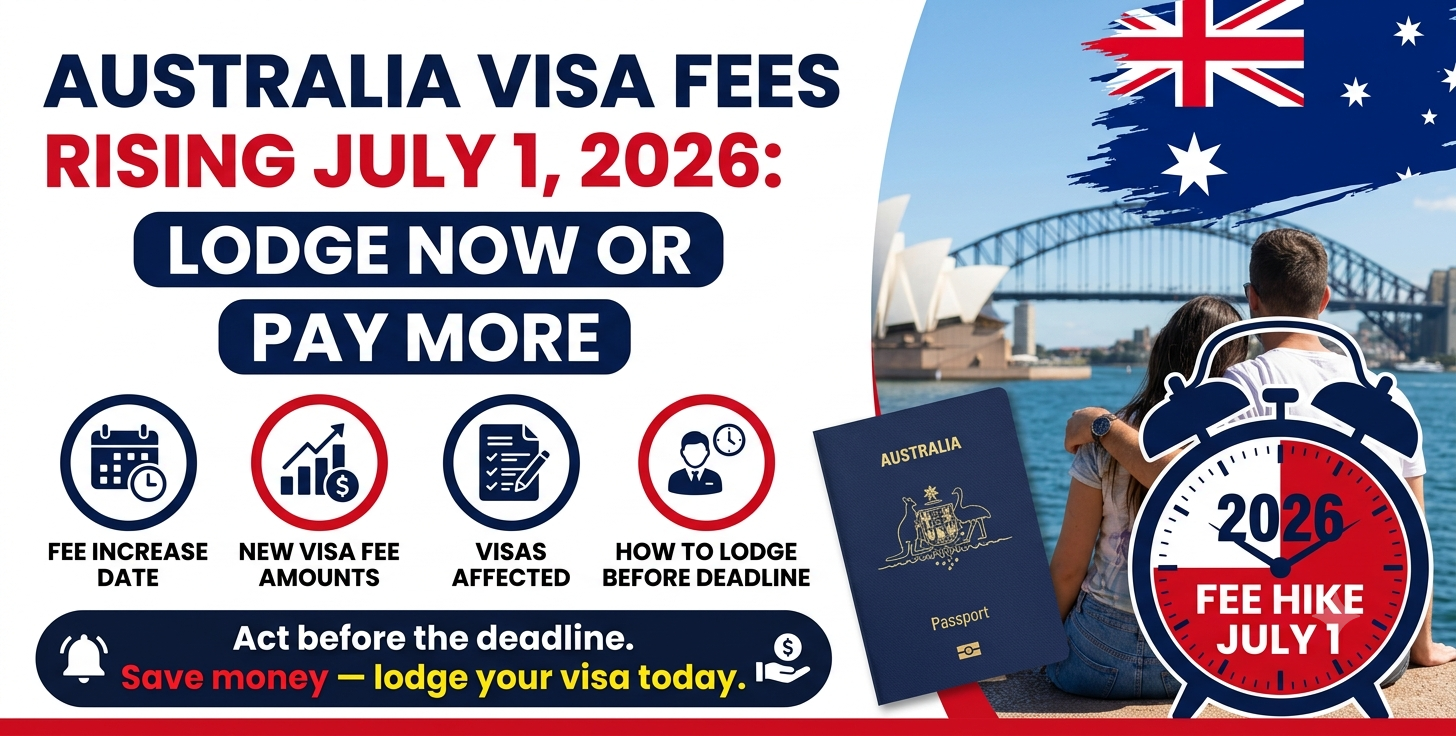
The Government of Australia has imposed an additional increase in application charges for visas, which has become effective from July 1 2026. According to the new tariff, the application fee for a Student Visa Subclass 500 is AUD 2,500. Australia now holds one of the top spots in the world in terms of costliness in relation to visa applications, together with tuition fees, Overseas Student Health Cover (OSHC), and living expenses. The key thing about visa application fees that a lot of people tend to forget is that these fees are calculated on the basis of when you lodge your application, not when the decision is made. This means students who submit their applications on or after July 1 2026 must pay the new fee, even if their visa is processed months later. So, if you have lodged the application before July 1, you follow the old payment scheme. However, if your visa application is lodged after July 1, you need to pay an increased amount.
In this blog, we shall go into details regarding the increased visa fee of Australia, including aspects such as things that changed on July 1, 2026, New Australia Visa Fee, the reason behind this increment of visa fees, the affected categories of people, and more. So, keeping this in mind, let’s get started!
Effective from July 1 2026, the Australian Government has imposed a new set of visa application charges in their annual review of the migration charges. While visa application fees tend to be updated on an annual basis, considering inflation through the use of CPI, the update for 2026 has exceeded what is normally done on an annual basis. Amongst the visa classes that have seen a great rise in their application fee is international students.
The one with the greatest change is the Student Visa (Subclass 500) where the application fee has risen from AUD 2,000 to AUD 2,500. In essence, this represents an extra AUD 500 per person applying, and this hike has followed the trend of rising prices of visas for student applicants. As such, Australia has become a more expensive country in regards to application fees for visas for international students.
The same case applies to the Student Guardian Visa (Subclass 590), which has risen from AUD 2,000 to AUD 2,500. Any parent or relative that accompanies a qualified international student to Australia must consider this higher application fee.
Another way in which the price hike has occurred is via the application fee for the Temporary Graduate Visa (subclass 485). This fee is AUD 5,750 and this type of visa is mainly used by international graduates seeking to gain some work experience in Australia.
Alongside these major increases, the government of Australia has also revised application charges across multiple temporary and permanent visa categories as part of its annual migration fee update. Although most of the visa fees generally rise alongside the Consumer Price Index (CPI), the changes of 2026 are considered significantly larger for student-related visas. Because of this recent trend of rise in visa fees, applicants are advised to always check the latest visa application charges before lodging their application, as the fee payable is based on the date of lodgement, not the date the visa is decided. The key changes include:
| Visa Type | Previous Fee | New Fee | Increase |
| Student Visa (Subclass 500) | AUD 2,000 | AUD 2,500 | AUD 500 |
| Student Guardian Visa (Subclass 590) | AUD 2,000 | AUD 2,500 | AUD 500 |
| Temporary Graduate Visa (Subclass 485) | AUD 4,600 | AUD 5,750 | AUD 1,150 |
The Australian Government reviews visa application charges as part of its broader migration and visa system management. The rise in cost from 1 July 2026 forms part of the annual review conducted by the government regarding visa costs, which applies to several types of visas, including student visas and temporary graduate visas.
According to the government, visa application costs contribute towards funding the migration program of Australia by paying for the processing and administration of visa applications. At the same time, the current changes come in the context of general reforms of the migration and international education systems in Australia, which have seen the government's efforts at ensuring the integrity of the visa system and that migration settings are consistent with national interests.
In Australia, there have been reviews of migration settings in order to make sure that the levels of migration in the country are sustainable and consistent with economic and social requirements.
Visa application charges contribute to the funding of Australia's immigration system. These funds support activities associated with visa processing, system improvements, compliance operations, and the administration of migration programs.
The Australian government has taken various steps in order to improve the integrity of the student visa program, including the GS requirement, which came into effect in 2024. An increase in visa fees is one of the elements of an overall environment of more stringent requirements for the demonstration by applicants that they satisfy all criteria and have a genuine intention to study in Australia.
An increase in visa fees goes along with various reforms in the international education sector of Australia. These reforms relate to the maintenance of education standards, improvement of regulation and assurance that the student visa program of Australia will keep serving the interests of international students.
Adjustments in visa fees are a part of Australia's migration strategy. The Australian government continuously assesses its visa settings, including visa application fees.
The fee increases have received criticism from universities and international education stakeholders. Education organizations have expressed worries regarding the higher costs of visas, which might add more financial pressure to international students and might reduce the competitiveness of Australia against other countries that serve as educational hubs. It was stressed that keeping the visa application fee affordable is essential in attracting more international students to Australia.
The increased costs of applying for an Australian visa will impact various applicants, most especially international students and their families, as they need to consider the higher cost when planning for studies. Considering that the fee depends on the date the application is submitted, any applicant applying on or after 1 July 2026 should bear the higher fee.
The biggest impact will be on students applying for their first Student Visa (Subclass 500). Students who plan to pursue studies in Australia will have to factor in the new visa application fee apart from tuition fees, Overseas Student Health Cover (OSHC), travel expenses, and living expenses.
For students from countries where currency conversion makes studies abroad expensive, the extra visa fee may be seen as an increase in their total expenditure for commencing an Australian education trip.
Nepalese students applying for education in Australia will have to take into account the extra visa application fee. Students will have to account for the extra visa fee along with other financial documents, tuition fees, etc.
This new fee does not imply that Nepalese students cannot apply for Australian visas; however, they must ensure that they fulfill all the visa criteria such as the GS criterion, financial capacity criteria, and course eligibility criteria.
Students who are already in Australia and planning to change their education provider may also need to consider how the new visa fee structure affects their circumstances.
In some cases, where the students change their course or provider, they might be required to make a fresh visa application. For any new application that is lodged on or after 1 July 2026, the visa application charge increase will be applicable.
Those who have been refused visas before and are making applications once again will be affected by the changes. The student will have to make payments for the revised application charge when lodging their visa application.
Before making the new visa application, they must be ready to present stronger evidence to convince the officials to give them permission.
The rise in the cost of visa applications will affect those individuals seeking the Student Guardian Visa (Subclass 590). Those parents or guardians accompanying international students to Australia will have to pay the revised visa application charge.
Parents preparing their child for studies abroad in Australia need to consider the cost of the guardian visa application.
The changes that have been applied to the fees for various student-related visas on 1 July 2026 did not stop there. Other temporary, family and skilled migration visa types have had application charge updates as part of the annual Australian visa fee review process by the Australian Government. These fees add up to make the total cost of applying for an Australian visa.
Another significant increase in the fee for the application of the Temporary Graduate Visa (Subclass 485) occurred on 1 July 2026, where the fee jumped from AUD 4,600 to AUD 5,750.
It is a very important migration pathway for eligible graduates in need of gaining valuable work experience in Australia after graduation.
Partner visa application charges were also increased as part of the 2026 visa fee revisions. These visas generally involve significant application costs, and the higher charges add to the financial requirements for Australian citizens, permanent residents, and eligible New Zealand citizens sponsoring their partners.
Potential applicants who intend to apply for partner visas should check the latest fees because the amount that one pays for their application will be dependent on the type of visa applied for and the circumstances of the visa application.
Applicants of skilled migration visas have also been affected by the changes in visa fees. There are increased application costs when applying for skilled migration visas, including temporary and permanent skilled migration visas.
Considering that the skilled migration process involves several steps, all the costs associated with it, including skills assessment fees, English language test fees, medical examination fees, and visa application fees, should be considered.
Besides the fee increases, many other visa subclasses have received annual increases in fees since 1 July 2026. This is due to the annual review of the visa application charges done by the Australian Government.
All visa applicants should ensure that they check the current visa application charge before they apply for a visa because it depends on the date of lodgment of the application and not the decision date.
The visa fee increase of 1 July 2026 significantly raises the initial cost of studying in Australia, especially for international students who are applying for Students Visa (Subclass 500). Although students who have already lodged visa applications before 1 July are not affected by the new charges, since significant time has passed since the announcement, current and future applicants are advised to stay updated regarding the new visa fee.
In this blog, we provided you with an update on recent visa increases by Australia alongside some complementary insights such as who is affected, and increases in other aspects besides the student visa fee. We hope you found this helpful. If you seek further insights into the various other aspects of visas, do check out some of our other blogs. And if you want the best visa services for Australia, look no further than Classic Migration. Our registered MARA migration agents in Canberra will assist you every step of the way with your visa application process in Australia.
The new visa application charges came into effect as of 1 July 2026. The applicable charge is determined by the date of lodgment of the visa application rather than the date when the visa application is decided. Applications received before 1 July 2026 will be subject to the old fees schedule, whereas the applications received after 1 July 2026 will have to pay the increased charges.
As of 1 July 2026, the fee for applying for the Student Visa (Subclass 500) went up from AUD 2,000 to AUD 2,500. If you are intending to study in Australia, you should consider this added cost along with tuition costs, OSHC, living costs, and any other associated costs of studying.
No, there is no direct influence on the chances of being granted an Australian student visa. You can apply just like usual, and the application will be evaluated taking into account eligibility criteria such as the Genuine Student (GS), financial, educational and documentary factors.