Friday, 12 Jun 2026
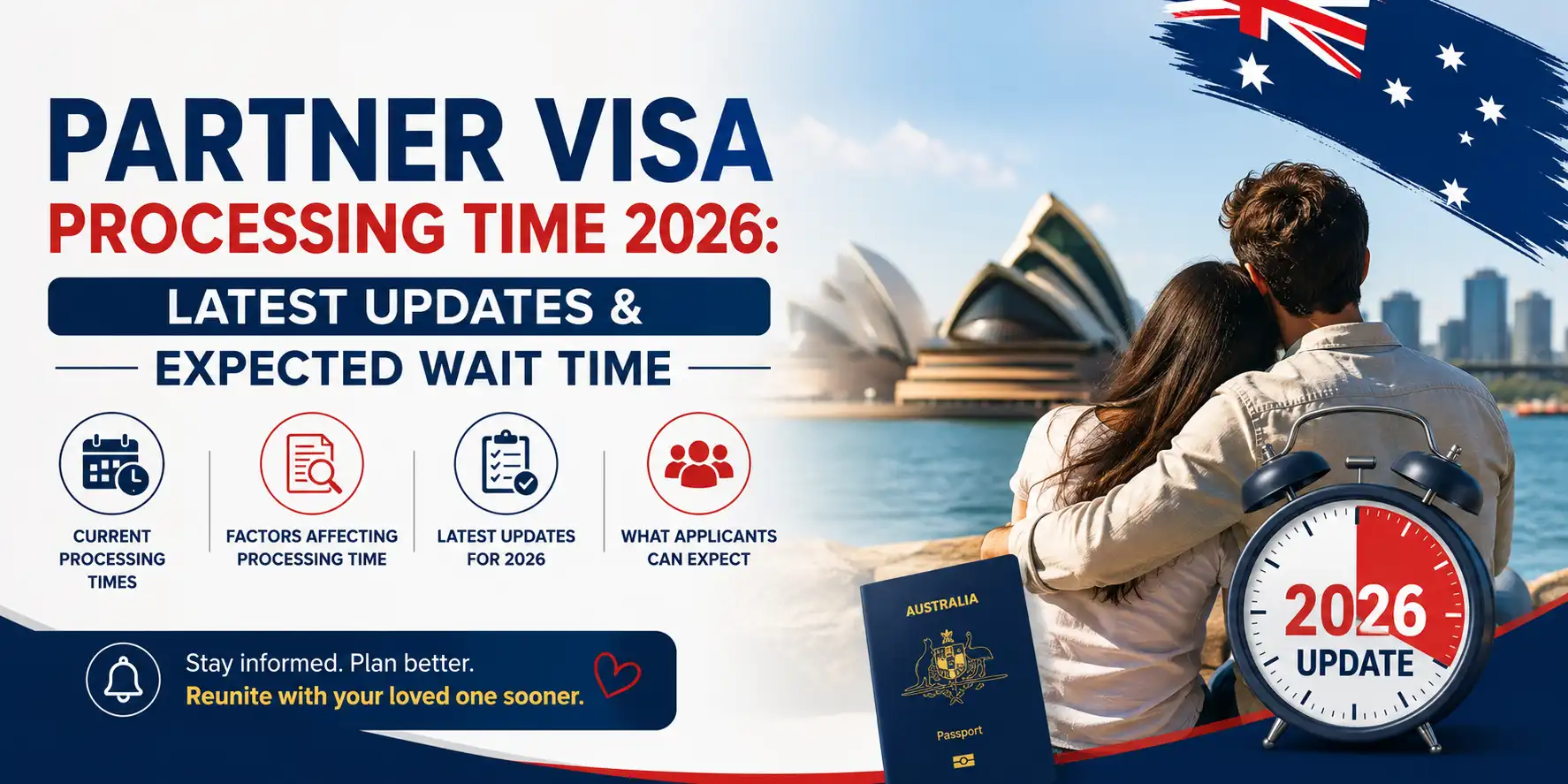
For those who intend to settle down in Australia, the Partner Visa is among the foremost ways through which couples can reunite and make a life together. However, one of the major concerns that people often raise when applying for such a visa is the issue of how long it takes for a partner’s visa to be processed. There are several factors that affect the processing time for a partner visa, such as visa subclass and application location. On top of this, there have been a few updates on expected wait times as well, such as 50% of subclass 820 visa applications being processed within 18 months and 90% within 32 months, to 50% within 16 months, 90% within 24 months. But this is not the only subclass of partner visa that has changed its expected wait time.
In this blog, we provide you with insight into the latest updates on partner visa processing time.
Although the criteria vary according to the specific subclass of Partners VISA applied for, some common conditions include being in a valid and current relationship with an Australian citizen, an Australian permanent resident, or an eligible New Zealand citizen. Health, character, and sponsor eligibility criteria apply.
The Subclass 820 is the initial phase for the onshore partner visa stream and is applicable to persons already living in Australia.
Eligibility requirements include:
The Subclass 801 visa is the permanent stage of the onshore partner visa pathway. Applicants are usually assessed around two years after lodging their combined 820/801 application.
Eligibility requirements:
The Subclass 309 visa is the first stage of the offshore partner visa pathway and is designed for applicants outside Australia.
Eligibility requirements:
The Subclass 100 visa is the permanent stage of the offshore partner visa pathway and is generally assessed about two years after the initial 309/100 application.
Eligibility requirements:
Processing time for the visa of Australian partners varies, depending on the individual. Although the same subclass visa can be applied for by multiple individuals, some applications will process quickly, while others take a relatively long time, depending on the specifics. Application completion
Completing the application form, as well as providing all the relevant evidence, is a crucial part of a visa application.
A strong, well-documented relationship that is genuine and continues can be assessed more quickly. Weak or limited evidence in the areas of financial, social and household commitments can slow down assessment.
Visas issued onshore (820/801) or offshore (309/100) are processed differently. Each pathway has a queue, eligibility timelines and stages. These factors directly influence the length of time it takes to process a case.
It can take a long time to get a police clearance if you have lived in several countries and have travelled sporadically.
As applications are processed according to priority and queue size, high-demand periods can result in longer waiting times.
Many applications involving prior marriages, children or long separations, as well as previous visa refusals, require additional checks and detailed reviews.
The processing time can be significantly extended if the Department of Home Affairs requests additional documents, but there is a delay.
It may be necessary to conduct a second assessment if the sponsoring partner is unable to provide information on past sponsorships, character issues, or eligibility.
One of the most common questions when it comes to Partner visa processing time is the difference between the offshore visa processing time and the onshore visa processing time. The answer to this question is that both the onshore and offshore partner visas have roughly similar processing times.
Onshore visas (Subclass 820/801) tend to have a slower temporary stage but a similar permanent stage timeline. The Subclass 820 takes about 16 months for 50% of cases and up to 24 months for 90%, while the Subclass 801 permanent stage is decided in about 8–26 months after eligibility.
Offshore visas (Subclass 309/100) are slightly quicker at the temporary stage for many applicants, with the Subclass 309 taking around 14 months for 50% of cases, but still reaching up to 24–26 months for 90%. The Subclass 100 permanent stage is often faster on paper, with 10–21 months processing times.
Understanding the current visa processing timeline for Partner Visa in 2026 is highly important if you are someone who is looking forward to travelling to Australia on a partnered visa. Doing so helps you keep realistic expectations and plan your migration journey ahead. Now, do note that although we are going to provide you with visa processing times, the actual time can differ case by case, and what we are presenting is just an average estimate. The following are Partner visa Australia 2026 updates.
For applicants already living in Australia, onshore partner visas follow a two-stage pathway that begins with a temporary visa and later leads to permanent residency. The overall processing times can vary on factors such as quality of the application, evidence of the relationship, and the overall complexity of the case. This category of partnered visa includes subclass 820 and subclass 801. The following are the Subclass 820 processing time and the Subclass 801 processing time:
For applicants applying from outside Australia, offshore partner visas also follow a staged process. These applications are assessed separately, and timelines can differ based on location, documentation strength, and background checks. The updated Subclass 309 processing time and Subclass 100 processing time are:
Also Read
Although we have discussed the factors affecting the visa processing time, here, let’s specifically look at the three leading causes that can delay partnered visa processing time. These three key reasons include:
One of the most common reasons for partner visa delay is the missing, incomplete documents or poorly structured applications. When you do not properly submit required key documents such as police clearances and medical examinations, the Department of Home Affairs often issues a request for further information under section 56 of the Migration Act. Each of these requests causes delays in the assessment process and can add multiple months to the overall processing time.
One of the key aspects of a partner visa is the relationship between the involved parties, and they are measured in four key relationship pillars. These four key pillars include: financial aspects, nature of the household, social recognition, and commitment to each other. If the department finds weakness in any of these areas, the application can take longer for processing and might even face additional examinations, further delaying the application process.
Any kind of inconsistency, even minor ones, such as dates, addresses or relations, may raise suspicions during the application process. Such inconsistencies may result in the necessity of carrying out further investigations and conducting additional checks. Such investigations might activate clauses such as Public Interest Criterion 4020. As a result, the processing time of your application may increase.
Although there is no way to shorten the processing time of a Partner Visa, you can reduce the number of delays caused by the application process. There are three main factors that help to speed up the Partner Visa application process. First, you should prepare yourself properly and pay attention to details. The Department of Home Affairs is known for its thorough approach. Thus, you should provide the documents needed for your application. These include:
Processing of partner visa applications will take place based on the type of application made in 2026. The general timeframe ranges between 10 months and a few years, but your visa application can be processed more quickly or can be delayed depending on the situation. A well-prepared, complete and consistent application is generally processed faster unless an unexpected circumstance occurs.
If you are unsure of how to begin the process or have more queries regarding partner visa processing, look no further than Classic Migration! We are one of the best MARA-registered agents and one of the best migration agents in Canberra. Your partner visa application will be assisted by us all the way!
The processing time for a partner visa application depends on the specific subclass of the partner visa being applied for and personal situations as well. In 2026, 50% of the temporary partner visa applications were processed in 14 -16 months, whereas some complex cases would take up to 24 months and even more.
A delay may happen because of an incomplete application, lack of convincing evidence of the relationship, discrepancies in the information given, failure to respond to inquiries on time or timely completion of health, character, and background investigations. An applicant should provide a properly organised and complete application to avoid any possible delays.
Unfortunately, there is no guarantee that the process of your Partner Visa application will be faster. However, in this case, it may still be possible for you to reduce the time taken through the process by submitting a complete application, having adequate proof of your relationship, and answering all questions in an appropriate way.